HSK 2
HSK 2 · App lesson 2
15-25 min 6 words Official 1.2/2 8 sections

Invite guests to eat, name a Beijing dish, and describe a meal that is complete.

New HSK Course 2, official lesson 1, part 2 of 2.
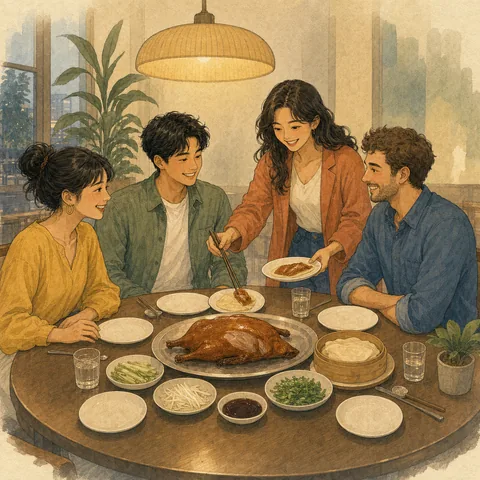
A friendly scene for a welcome dinner
Vocabulary overview

First, see the whole set.

That evening, the airport welcome continues over dinner. These six words complete the official lesson title.

Vocabulary 01 / 06
01 A friendly illustration showing to treat
(qǐng)

to treat; to invite

Model sentence
What to notice

Here it means paying for someone's meal, not just 请 as in 请进.

Try it

Pattern: 请 + person + verb (+ food).

Vocabulary 02 / 06
02 A friendly illustration showing we
()(men)

we; us

Model sentence
What to notice

The plural form of 我.

Try it

Listen for it after 请 when someone treats a group.

Vocabulary 03 / 06
03 A friendly illustration showing to eat
(chī)

to eat

Model sentence
What to notice

Follows 请 + person in this lesson's main pattern.

Try it

Add 了 after 吃 when the meal is already finished.

Vocabulary 04 / 06
04 A friendly illustration showing completed action marker
(le)

completed action marker

Model sentence
What to notice

Placed after the verb to show the action is done.

Try it

Compare 请我们吃 (will treat) with 请我们吃了 (already treated).

Vocabulary 05 / 06
05 A friendly illustration showing Beijing
(běi)(jīng)

Beijing

Model sentence
What to notice

China's capital, and home of the dish in this lesson.

Try it

It often comes right before 烤鸭 as a set phrase.
Vocabulary 06 / 06
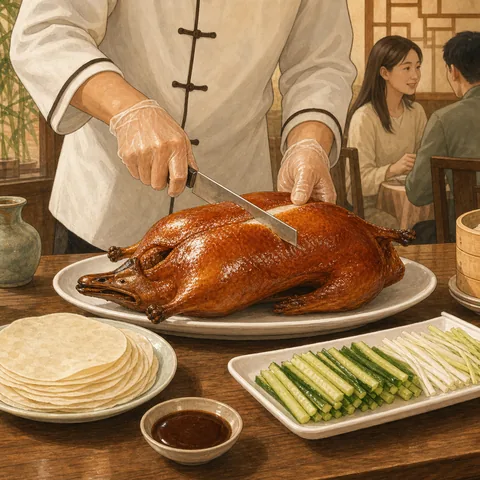
06 A friendly illustration showing roast duck
(kǎo)()

roast duck; Peking duck

Model sentence
What to notice

A famous Beijing dish, and the heart of this lesson's story.

Try it

Say the full name 北京烤鸭 when ordering or describing it.

Vocabulary match

Connect word, pinyin, and meaning.

Pick one item from each column. When all three belong together, they lock in as a match.

Word
    Pinyin
      Meaning
        Grammar

        Two patterns hold the lesson together.

        Put the guest after 请, then add 了 after the verb when the action is finished.

        Grammar 01 / 02
        请 + person + verb (+ object)

        Treating someone with 请

        Use 请 to say someone treats or invites another person to do something, often to eat. The person receiving the treat comes right after 请.

        Grammar 02 / 02
        verb + 了

        Completed actions with 了

        Add 了 after a verb to show the action is finished. In this lesson it turns 请我们吃 into 请我们吃了, so the meal already happened.

        Writing drill

        Type your answer.

        Translate: She treated us to Peking duck.

        Pattern: 请 + person + verb (+ food).

        Writing drill 02 / 02

        Type your answer.

        Write the Chinese word for "roast duck".

        A famous Beijing dish, and the heart of this lesson's story.

        Reading practice

        Continue in order when you can. You can also open any app lesson whenever it is useful.

        (wǎn)(shàng)(chī)(kǎo)()

        Peking duck that evening

        ()()(qǐng)(chī)(běi)(jīng)(kǎo)()

        ()()(běi)(jīng)(kǎo)()(hěn)(hǎo)(chī)

        (ān)()谢谢(xièxie)()(qǐng)()(men)(chī)(fàn)

        ()()()(men)()(jīng)(chī)(le)

        Reading check

        Did you follow the story?

        Choose the best answer for each question.

        Question 1: What do the guests eat?
        Question 01

        What do the guests eat?

        Question 2: Who treats the group to dinner?
        Question 02

        Who treats the group to dinner?

        Writing practice

        Write a full sentence.

        Write one sentence saying she treated us to Peking duck.

        Review

        Quick recall check.

        Type your answer in Chinese or English where it fits.

        Which new word means "to treat"?

        Review 02 / 02

        Quick recall check.

        Type your answer in Chinese or English where it fits.

        Which new word means "roast duck"?

        Lesson complete

        Nice work finishing this part.

        Review this app lesson whenever you need it, or continue when you feel ready.

        Would you like more lessons like this one?