HSK 3
HSK 3 · App lesson 2
15-25 min 5 words Official 1.2/5 8 sections

Pick up arriving friends, identify a missing suitcase, and use its number to describe it clearly.

New HSK Course 3, official lesson 1, part 2 of 5.
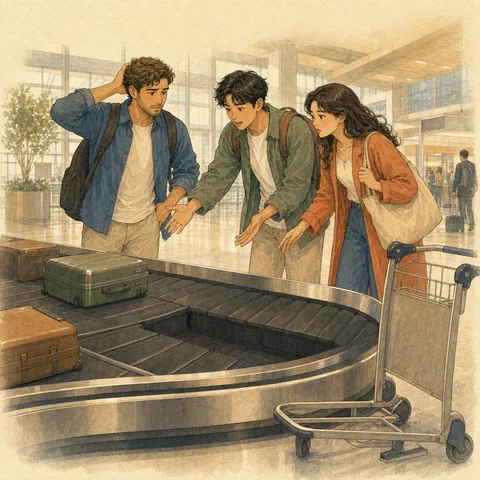
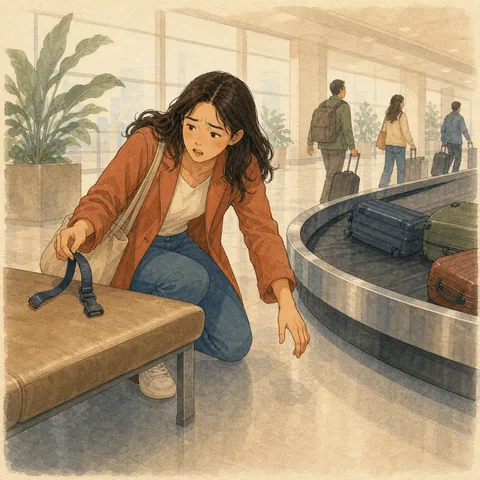
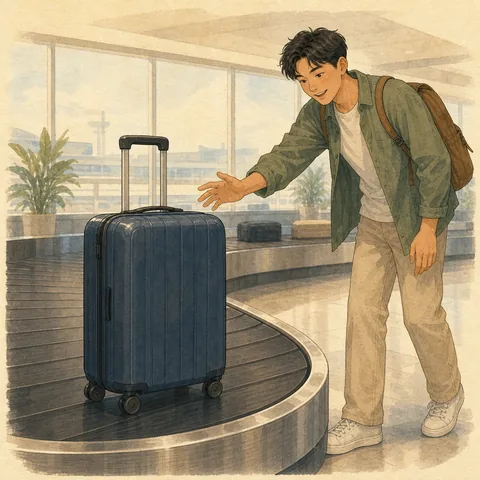
A friendly scene for a suitcase goes missing
Vocabulary overview

First, see the whole set.

At the arrivals hall, the welcome is interrupted by a missing bag. The five words belong to one practical problem.

Vocabulary 01 / 05
01 A friendly illustration showing to meet
(jiē)

to meet; to pick up

Model sentence
What to notice

Used when you go somewhere to meet someone arriving.

Try it

Pattern: 去 + place + 接 + person.

Vocabulary 02 / 05
02 A friendly illustration showing luggage
(xíng)()

luggage; baggage

Model sentence
What to notice

Usually refers to bags when traveling.

Try it

Combine it with 箱子 for 行李箱.

Vocabulary 03 / 05
03 A friendly illustration showing to lose
(diū)

to lose

Model sentence
What to notice

丢了 marks that something is lost now.

Try it

Use object + 丢了.

Vocabulary 04 / 05
04 A friendly illustration showing case
(xiāng)()

case; suitcase; trunk

Model sentence
What to notice

A general word for a box, case, or suitcase.

Try it

Describe it with color + 的 + 箱子.

Vocabulary 05 / 05
05 A friendly illustration showing number
(hào)()

number

Model sentence
What to notice

Used for phone numbers, room numbers, and other IDs.

Try it

Practice 电话号码 as one chunk.

Vocabulary match

Connect word, pinyin, and meaning.

Pick one item from each column. When all three belong together, they lock in as a match.

Word
    Pinyin
      Meaning
        Grammar

        One pattern holds the lesson together.

        Put the lost item before 丢了. This short pattern clearly reports the problem.

        Grammar 01 / 01
        item + 丢了

        A lost item with 丢了

        Place the missing item first, then use 丢了 to say it has been lost. The completed situation marker 了 shows that the item is now gone.

        Writing drill

        Type your answer.

        Translate: I'm going to the airport to pick them up.

        Pattern: 去 + place + 接 + person.

        Writing drill 02 / 02

        Type your answer.

        Write the Chinese word for "number".

        Used for phone numbers, room numbers, and other IDs.

        Reading practice

        Continue in order when you can. You can also open any app lesson whenever it is useful.

        (zài)(xíng)()(chù)

        At the baggage area

        ()()(yǒu)(rén)(lái)()(chǎng)(jiē)()(men)

        (bái)(jiā)(yuè)()(shì)()(de)(xíng)()(xiāng)(diū)(le)

        ()()(xiāng)()(shàng)(yǒu)(hào)()(ma)

        (bái)(jiā)(yuè)(yǒu)(shàng)(miàn)(yǒu)()(de)(diàn)(huà)(hào)()

        Reading check

        Did you follow the story?

        Choose the best answer for each question.

        Question 1: What is missing?
        Question 01

        What is missing?

        Question 2: What is written on the suitcase?
        Question 02

        What is written on the suitcase?

        Writing practice

        Write a full sentence.

        Write one sentence saying your suitcase is lost.

        Review

        Quick recall check.

        Type your answer in Chinese or English where it fits.

        Which new word means "to meet"?

        Review 02 / 02

        Quick recall check.

        Type your answer in Chinese or English where it fits.

        Which new word means "number"?

        Lesson complete

        Nice work finishing this part.

        Review this app lesson whenever you need it, or continue when you feel ready.

        Would you like more lessons like this one?